Chemical Tempering - http://www.bycunited.com/en
Main menu:
Technology
Chemically Toughened Glass
Chemical toughening is analogous to physical tempering as it creates a state of compression at the glass surface. Therefore it is sometimes termed as chemical tempering. Chemical tempering, chemical toughening and chemical strengthening are used interchangeably in the literature.
Chemical toughening, as offered by BYC, uses an ion exchange mechanism whereby Na+ ions are substituted with K+ions at the surface. K+ ions have larger ionic radii (99pm) in comparison to Na+ (73pm), and their presence in the glass network creates the desired state of compression near the glass surface. The compressive stresses that build up as a result of ion exchange process may reach up to 500 MPa for a Soda-Lime-Silicate glass. The basic mechanism has been around since 1962 and still retains its relevance to this day. ( Kistler, S.S., ‘‘Stresses in Glass Produced by Non uniform Exchange of Monovalent Ions,’’ J. Am. Ceram. Soc., 45 [2] 59–68 (1962).)
To realize ion exchange, the untreated glass part is dipped into a hot alkaline salt solution typically held at 400-450 oC. As ion exchange is a diffusive process the main process parameters are temperature and time. These two variables are adjusted to achieve the desired state of strengthening for a glass of given thickness and composition. The following observations should be considered whenever a decision is to be made on the appropriate strengthening route:
- Chemically toughened glass is not considered a safety glass because it shatters with sharp slivers. If a proper safety glass is needed it can be used as such in the laminated form.
- Chemical strengthening is a slow procedure and for a single article it will take anywhere from a few hours to a few days. Long immersion times render this procedure more costly in comparison to physical tempering.
- Chemical tempering is a superficial treatment therefore deep scratches shall result in the loss of added strength in their close proximity.
- Fused silica, borosilicate and sapphire articles do not benefit from this procedure.
On the other hand chemical strengthening offers the following advantages:
· Optical distortions such as iridescence do not arise after chemical tempering.
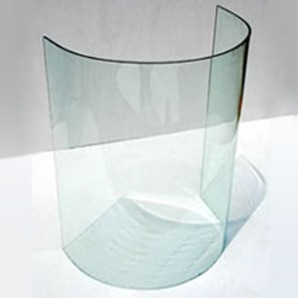
· Articles of complex shapes can be treated efficiently.
· Thin glass samples (typically <2mm) can only be strengthened with the chemical tempering procedure.
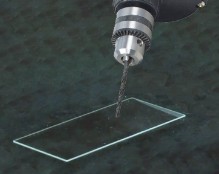
· Unlike the case for physical tempering, chemically tempered glasses can be machined and cut after strengthening. However, the machined samples will lose their strength around the cuts (about 1 inch from the interface).
At BYC United we can treat the glass specimens with the following dimensions:
Thickness Length × Width Shapes
0.5-19 mm 10mm × 10mm to 1200 mm × 2000 mm Flat and Curved